Yamaha Pacifica 112V: The Beginner Guitar Forums Love
Ask “what’s the best beginner electric?” in any English-speaking guitar forum and one name comes up again and again: the Yamaha Pacifica 112V. It rarely has the loudest fanbase, yet it’s quietly become the default recommendation of teachers and seasoned players. Here’s an honest round-up of what owners actually report.
Where these takes come from
A synthesis of recurring opinions from English-speaking communities (r/Guitar, Ultimate Guitar) and beginner-focused teachers. The focus: what matters for a first guitar — consistency, comfort and versatility.
What owners love
Consistency you can count on
The most repeated praise: unlike many budget guitars, the Pacifica isn’t a “lottery.” Owner after owner reports a well-built, well-finished instrument — which is exactly what a beginner needs.
It arrives playable
Factory setups are generally good: decent action, clean frets. For someone who can’t yet set up a guitar, that’s a huge head start.
HSS versatility (with a coil split)
A humbucker plus two single-coils, often with a coil split, covers clean sparkle to rock crunch. Owners say it’s a guitar you can grow with for years rather than outgrow.
What owners flag
1. The looks are “sensible”
The most common gripe isn’t technical: the Pacifica is seen as a bit plain. Players chasing an aggressive or metal aesthetic often look elsewhere.
2. Stock pickups are good, not amazing
They do the job, though some find the split coil a touch low in output. Pickups are the usual first upgrade if you want to push the guitar further.
3. Hardware is functional
Tuners and bridge are fine rather than premium — no real issue for a beginner, and easy to upgrade later.
Pacifica 112V vs the guitars it gets compared to
Here is the shortlist that appears in nearly every “first electric” thread, with the Pacifica’s siblings included because the names confuse a lot of first-time buyers. Prices are wide ranges observed in 2026 for new instruments; they shift with finishes and promotions, so check current listings.
| Model | Best for | Strengths | Weaknesses | Price range observed 2026 |
|---|---|---|---|---|
| Yamaha Pacifica 112V | The safe first electric for any style | Alnico HSS pickups with coil split, consistent build, arrives playable, alder body | Plain looks, functional hardware, split-coil output a touch low | Roughly $300–$400 (check current listings) |
| Yamaha Pacifica 112J | Buyers who want the Pacifica shape for less | Same body shape and neck feel, still well built | Ceramic pickups, no coil split — the version most owners say to skip if you can afford the V | Roughly $200–$300 (check current listings) |
| Squier Classic Vibe Stratocaster | Players who want the iconic Strat and real single-coil chime | Alnico single-coils, great neck, vintage looks, strong resale | No humbucker, so less rock thickness; single-coil hum | Roughly $400–$550 (check current listings) |
| Squier Affinity Stratocaster | Strictest budgets, mod platform | Light, cheap, easy to find used | Ceramic pickups, basic tuners, more variable finishing than the Pacifica | Roughly $220–$320 (check current listings) |
| Epiphone Les Paul Studio | Rock and blues players who want humbucker warmth first | Two humbuckers, set neck, sustain | Heavy, less versatile for clean styles, costs more | Roughly $450–$650 (check current listings) |
This page contains affiliate links. If you buy through them, we may earn a commission at no extra cost to you.
How the Pacifica compares to its usual rivals
In beginner threads, the Pacifica 112V is almost always weighed against two rivals: the Squier Classic Vibe and the Epiphone Les Paul. The recurring community view is that each wins on different ground. Against the Squier Classic Vibe, owners tend to give the Pacifica the edge on out-of-the-box consistency and its more versatile HSS layout, while conceding that the Squier delivers the iconic Strat and Tele shapes and that unmistakable single-coil chime. Against an Epiphone Les Paul, the comparison is really single-coil versatility versus humbucker thickness and weight — the Pacifica is lighter and more all-round, the Epiphone warmer and more rock-focused.
The consensus that emerges is not that the Pacifica is objectively “best,” but that it is the safest default: the guitar least likely to disappoint whatever style a beginner drifts towards. That reliability, more than any single feature, is what keeps it at the top of recommendation lists.
The upgrade path owners suggest
A recurring theme among longer-term owners is that the Pacifica is a guitar you can grow into rather than one you need to replace. Because the platform is so solid, the upgrades people mention are refinements, not rescues. The most common first change is the pickups, particularly for players who find the coil-split single-coil tones a touch low in output; a modest pickup swap is frequently described as making a good guitar great. Beyond that, owners occasionally mention upgrading the tuners or having a proper setup done to sharpen an already-decent factory job.
Importantly, the community framing is that none of this is necessary to enjoy the guitar — it plays well as it comes. The upgrades are simply available as your ear develops, which is part of why the Pacifica is seen as a long-term keeper rather than a stepping stone.
Which Pacifica to buy
The 112V is the model that dominates the discussion, and for good reason: its HSS pickup layout (one humbucker, two single-coils) with a coil split is the sweet spot of versatility and value that owners keep recommending. Yamaha does offer other variants in the range with different pickup configurations and price points, but the community’s clear default for a first electric remains the 112V, precisely because it does a bit of everything without a weak spot. If you’re choosing purely on the strength of forum consensus, the 112V is the one that earns the recommendations.
One practical note, because the model codes trip people up: the 112J looks almost identical in photos but uses ceramic pickups and has no coil split, and the even cheaper 012 sits below that. If a listing is suspiciously cheap, check the exact code — the “V” is the one the forums are talking about. Yamaha has also introduced higher-end Pacifica Standard Plus and Professional models in recent years; they are very good, but they play in a different price league and are not what beginner threads mean by “the Pacifica.”
New or used: what to check on a Pacifica
Because Yamaha’s consistency is so good, buying a Pacifica used is lower-risk than most beginner guitars, and I’d happily point a first-time buyer at the second-hand market. Even so, a quick inspection saves headaches.
On a used 112V
Pull the tone knob up and down: the push-pull coil split is the one part that sees the most abuse, and a loose or crackly pot is the most common fault I see reported. Sight down the neck for straightness, check the first five frets for divots, and make sure the vintage-style tremolo sits flat against the body if the previous owner never used the bar. Rusty saddles are cosmetic but tell you the guitar lived somewhere damp.
On a new one
Out of the box, the main things to confirm are that the nut slots aren’t cut high (the open-position chords should feel as easy as the twelfth fret) and that the humbucker and both single-coils all work in every switch position. Yamaha’s factory setup is usually good, but shipping and temperature changes can move a neck, so a light truss-rod tweak after a couple of weeks is normal rather than a defect — see why a setup is the best money you’ll spend.
Which amp to pair it with
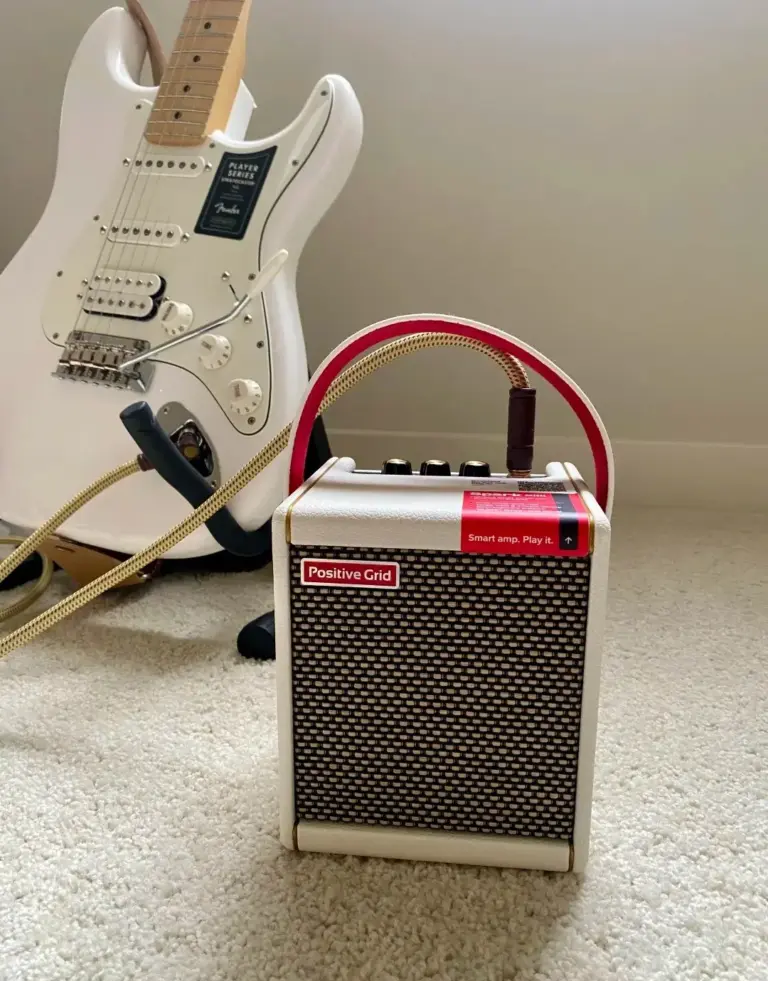
The Pacifica’s whole selling point is versatility, so it makes sense to pair it with an amp that is equally open-minded. The pairings that come up over and over in beginner threads are the Boss Katana (its clean channel loves the single-coils and its Brown channel makes the humbucker sound far bigger than the guitar’s price), the Fender Mustang LT25 for a compact, easy-to-use option, the Positive Grid Spark for app-based practice and backing tracks, and the Yamaha THR10II if you play at desk volume and want a matching brand on the shelf. I’ve gone through the trade-offs in the best first guitar amps under $200 and, if you’re leaning Boss, in our Katana owner review. One thing I’d avoid: a tiny 10-watt practice combo with no clean headroom — it’s the number-one reason people think their Pacifica sounds “thin.”
Mistakes to avoid when buying
- Buying the 112J by accident. It’s a decent guitar, but the ceramic pickups and missing coil split are exactly the two things owners praise on the V.
- Paying near-new money for a used one. Pacificas hold value well, but a used 112V should still be clearly cheaper than a new one; otherwise take the warranty and the returns window.
- Expecting a metal guitar. The humbucker handles rock and hard rock comfortably; for down-tuned, high-gain styles you’ll be happier with a dedicated design — see our beginner metal guitars.
- Skipping the accessories budget. A tuner, strap, spare strings and a gig bag are not optional, and forgetting them is one of the classic beginner buying mistakes.
Who it’s really for
The Pacifica is the safe, teacher-approved first electric for almost any style — and a guitar you keep. It’s less ideal if you specifically want a metal look or vintage single-coil chime. Compare options in our best under $500 and how to choose your first guitar.
My honest take
The community consensus is hard to argue with: the Pacifica 112V is one of the most reliable first guitars you can buy, mainly because of its consistency and out-of-the-box playability. Its few weaknesses (plain looks, average hardware) are minor and easy to fix.
Riffbound verdict
Who it’s for: The beginner who doesn’t yet know what style they’ll settle into, the parent buying for a teenager, and anyone who values “it just works” over looks. It is the guitar I recommend when someone asks me for one name and no follow-up questions.
Who should skip it: Players who already know they want the Strat or Tele look and single-coil chime specifically, and anyone chasing a pointy, high-gain metal machine. Also skip the 112J if the 112V is within reach.
The alternative worth a look: The Squier Classic Vibe Stratocaster for the classic Fender feel — our Classic Vibe vs Affinity comparison explains which tier to go for — or, on a tighter budget, the head-to-head Pacifica 112V vs Squier Affinity Stratocaster.
Based on owner and teacher feedback, no paid testing. How we review.
FAQ
Why do forums recommend the Pacifica so much?
Consistency and value: it plays well out of the box and rarely has the QC surprises common at this price.
Pacifica or Squier for a first guitar?
Both are excellent. The Pacifica wins on out-of-the-box consistency; the Squier gives you the iconic Strat/Tele shapes. See our Squier comparison.
Is it versatile enough?
Yes — the HSS layout covers most styles. For extreme metal, a hotter-pickup guitar suits better, but it still holds its own.
Does it need a setup?
Often less than rivals, since factory setups are good — but a quick adjustment never hurts.
What’s the difference between the Pacifica 112V and 112J?
The 112V has alnico pickups and a push-pull coil split on the tone control; the 112J has ceramic pickups and no split. They share the same body shape and general feel, which is why owners say the V is worth the modest extra cost.
Is the Pacifica 112V good for a child or a small player?
It’s a full-size guitar with a standard scale length, so it suits teenagers and adults. For younger children, a short-scale or 3/4-size instrument is usually the better fit, and our guide on what age to start guitar goes into the details.
Sources and method
This synthesis is based on owner and teacher feedback read on the following communities (consulted in 2026): “first electric guitar” recommendation threads, long-term Pacifica ownership reports and comparisons against Squier and Epiphone models.
- r/Guitar (owner feedback, very high volume)
- Ultimate Guitar (reviews and forums)
- Manufacturers’ official spec sheets (yamaha.com for the Pacifica range, fender.com for Squier, epiphone.com for the Les Paul Studio)
We receive no free gear and no brand reads our articles. Merchant links are affiliate links: how we work.