Best Guitar Amps for Home Practice
The best amp for home practice isn’t the loudest or most expensive — it’s the one you’ll actually use without annoying the neighbours. Here’s what matters when buying a practice amp, and which type to choose.
Keep the wattage low
For a flat or bedroom, 5–20 watts is plenty. High-wattage tube amps need volume to sound their best — useless (and antisocial) at home. Lower-powered amps let you get good tone at livable levels.
Modeling amps are the practical winner
A small modeling amp packs many amp voices and effects into one box, with presets for clean, crunch and high-gain. For the price and versatility, it’s the most sensible home choice today — and you can explore tones without buying pedals.
Headphone output is a game-changer
Silent practice via headphones means you can play any time without disturbing anyone. Many modern practice amps (and tiny “headphone amps”) offer this — a must for apartments.
The home practice amps I’d shortlist, side by side
This guide is about the amp you’ll use at home, whatever your budget — if your hard ceiling is $200, my first amp under $200 round-up is the better starting point. Price ranges are what I observed in 2026 and they move constantly; check current listings before deciding.
| Amp | Best for | Strengths | Weaknesses | Price range observed 2026 |
|---|---|---|---|---|
| Boss Katana-50 (MkII / Gen 3) | One amp that also works for rehearsals later | Five voicings, deep effects, USB recording, Tone Studio editor, loud when needed | Bigger than a desk amp, stock presets need work | Roughly $250–$350 |
| Boss Katana Mini | Desk or travel, battery practice | Tiny, cheap, honest tones, headphone out | No USB or software, three voicings | Roughly $90–$130 |
| Fender Mustang LT25 | Budget modeling with a screen | Many models and effects, easy presets, USB | Small speaker, bedroom only | Roughly $130–$180 |
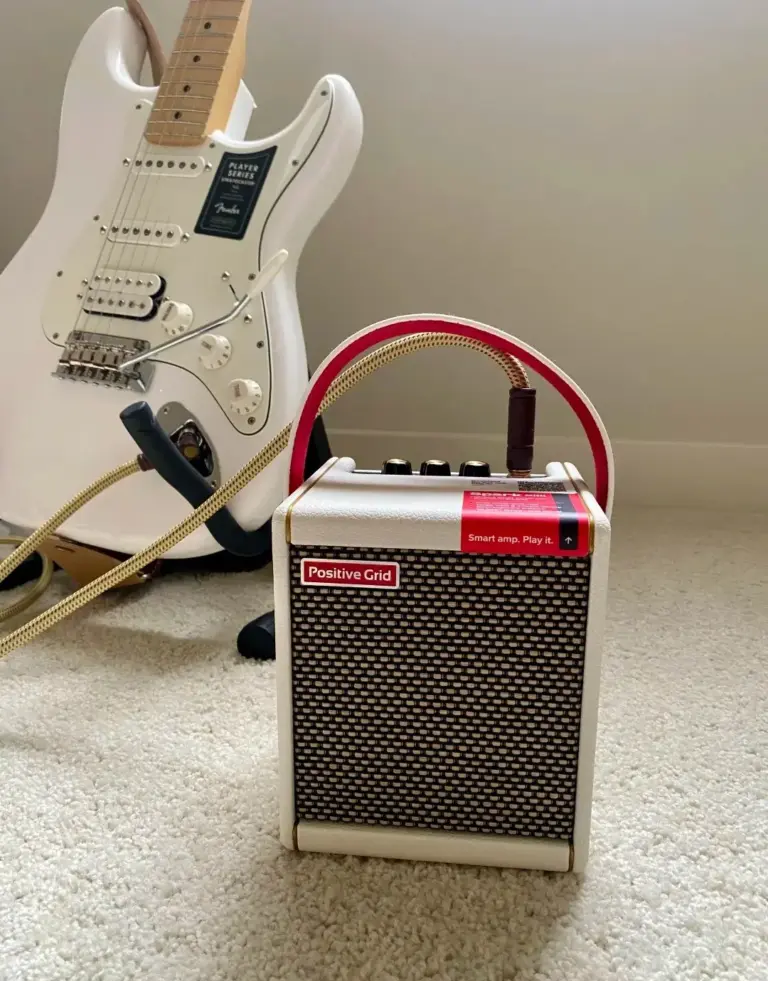
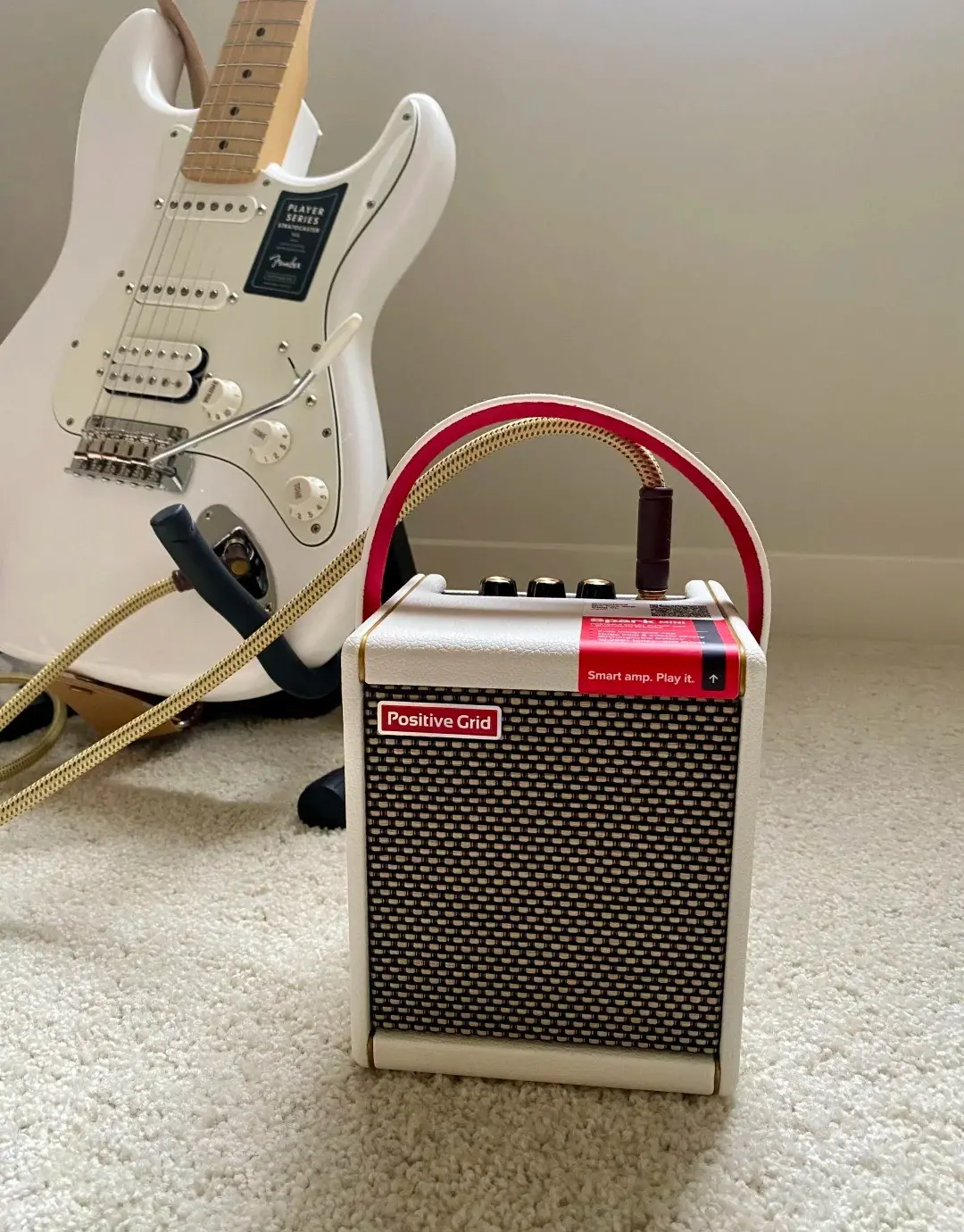
| Positive Grid Spark 40 | Play-along and app-driven practice | Superb app, Bluetooth, backing-track tools, full stereo sound | App dependence, not a rehearsal amp | Roughly $250–$350 |
| Yamaha THR10II | Desktop tone at whisper volume | Sounds beautiful quietly, stereo, tidy on a desk, USB | Pricier, fewer effects, home use only | Roughly $300–$400 |
| Blackstar ID:Core 10 / 20 | Stereo tones on a small budget | Stereo speakers, several voicings, effects, USB on current versions | Small speakers, app needed for deep edits | Roughly $120–$200 |
| Orange Crush 20RT | Simple rock with zero menus | Great drive channel, reverb and tuner, cab-sim headphone out | No modeling, no USB | Roughly $170–$230 |
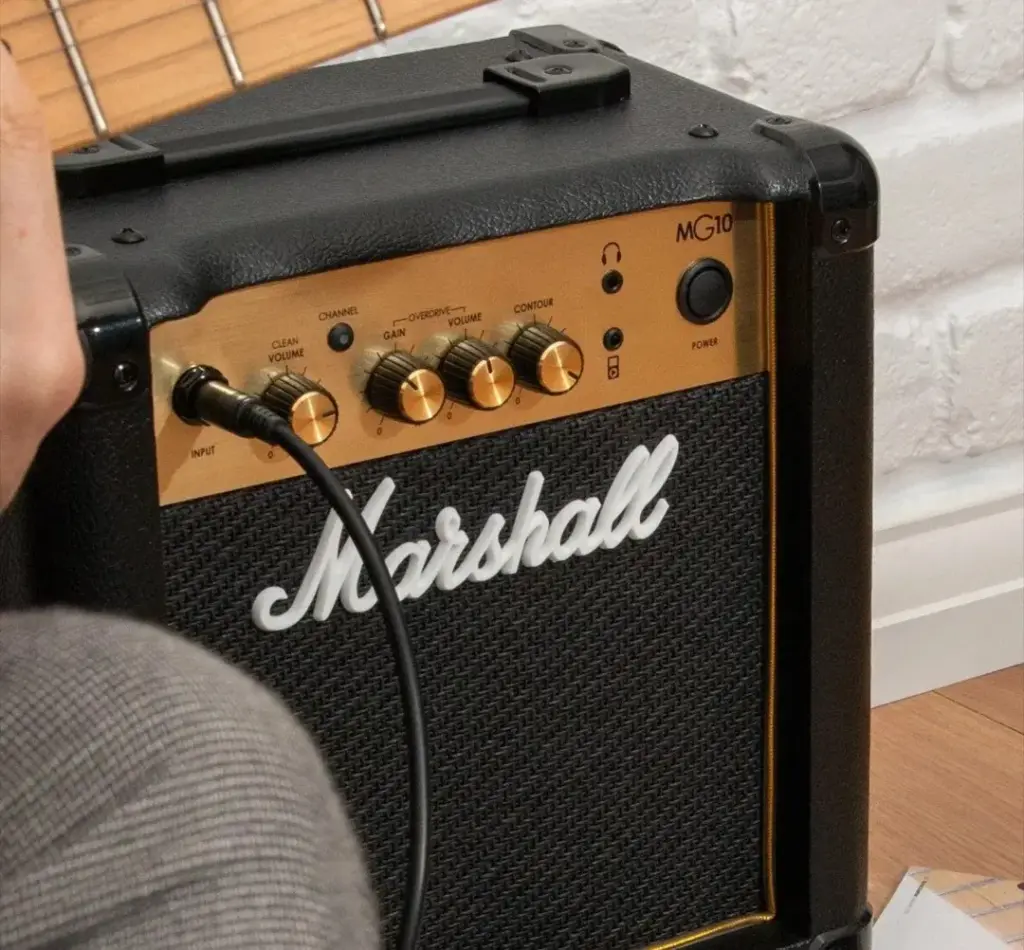
| Marshall MG15 / MG15G | Classic crunch on a tight budget | Simple, sturdy, headphone out | Limited cleans, no recording features | Roughly $120–$180 |
This page contains affiliate links. If you buy through them, we may earn a commission at no extra cost to you.
Built-in features worth having
- Aux/Bluetooth in to play along with tracks.
- Onboard effects (reverb, delay, drive).
- A tuner and simple presets.
Tube vs solid-state vs modeling
Quick version: tube amps feel wonderful and respond to your picking, but they need volume to get there and the small ones are pricey for what they do at home. Solid-state amps like the Orange Crush or Marshall MG are cheap, sturdy and consistent at any volume, with one or two good tones and no menus. Modeling amps such as the Katana, Mustang and Spark simulate many amps and effects digitally, sound good quietly by design, and usually add USB recording. For a bedroom, modeling wins on sheer usefulness; solid-state wins on simplicity; tube is a treat you buy later, once you know what you want it to sound like.
Watts, decibels and the loudness myth
Beginners often assume more watts means better tone, but for home practice the opposite is closer to the truth. Watts measure power, not quality, and a high-wattage amp only sounds its best when pushed to volumes that are impractical (and antisocial) in a flat. Worse, loudness doesn’t scale the way you’d expect: doubling the wattage adds only a small increase in perceived volume, because our ears respond to sound logarithmically. A 10-watt amp is already loud enough to be uncomfortable indoors.
For a bedroom or apartment, 5 to 20 watts is ample, and lower-powered amps let you reach a satisfying tone at a livable level. Save the big amps for a band rehearsal or stage, where the extra headroom actually earns its keep.
Speaker size, and why small amps can sound big
An amp’s tone isn’t just about its electronics — the speaker shapes the sound enormously. Larger speakers (10″ or 12″) move more air and give a fuller low end, while small practice amps with a 6.5″ or 8″ speaker sound tighter and more focused, which is often fine at home. Modern modeling amps compensate cleverly with digital speaker simulation, so even a compact box can produce convincing tones through headphones or a recording interface.
If you want the most tone from a small footprint, look for a modeling amp with a decent-sized speaker and quality onboard effects. It will out-perform a larger, simpler amp played quietly, because it’s designed to sound good at low volume rather than only when cranked.
Headphone amps and interfaces: the silent alternatives
You don’t strictly need a traditional amp at all. Two increasingly popular alternatives suit apartment players especially well. A tiny headphone amp plugs straight into the guitar’s output jack and feeds headphones directly — pocket-sized, cheap and completely silent to everyone but you. Or an audio interface connects the guitar to a computer or phone, letting you use amp-simulator software with a huge range of tones, record your playing, and jam along to backing tracks.
Both options give you full, satisfying tone at zero volume, which is a genuine game-changer for late-night or shared-space practice. Many players keep a small combo amp for feel and a headphone solution for silent sessions.
How I’d use it day to day
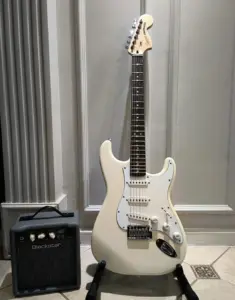
The amp that gets used is the one that’s already switched on, so my first piece of advice has nothing to do with tone: keep it plugged in, on a shelf or desk at hand height, with the guitar on a stand next to it. A practice amp in a cupboard is a decoration.
Two presets, not twenty
Whatever modeling amp you buy, set up one clean sound and one crunch sound with a touch of reverb and stop there. The forums are full of people who spent their first month scrolling through patches and their second month wondering why they hadn’t learned anything. Chords and scales sound fine through a clean preset; effects can wait.
Headphones at night, speaker in the day
I do most of my slow, repetitive practice — the boring stuff that actually builds technique — through headphones, and I save the speaker for playing along with tracks when nobody minds. An amp with a proper headphone output makes that switch a one-second job. If yours has an aux input or Bluetooth, playing along to a metronome app or a backing track is the fastest way to make practice feel like music.
Record something once a week
The USB output on amps like the Katana, Mustang LT25 and THR10II is the feature people ignore for a year and then can’t live without. A thirty-second phone-quality recording of yourself every week tells you more about your progress than any app score.
New or used for a home amp
Small practice amps live gentle lives, and the second-hand market is full of them at a fraction of the new price, often sold by people who gave up. There’s no tube to wear out and nothing to service, so a used Katana-50, Mustang LT25 or THR10II is a sensible buy as long as every knob and socket works, the speaker doesn’t rattle on a low clean note, and the software for that exact model is still downloadable. Where new makes more sense: if you can’t test it first, if the saving is small, or if the seller is asking near retail. The one thing I’d never buy used without playing it is a tube amp, where worn tubes and old capacitors can hide real repair costs. For more on what owners say about the most common used find of all, see my Katana owner reviews.
Before you order: the checklist
- Where will it sit? Desk: Katana Mini, Spark Mini, THR10II. Floor: Katana-50, Mustang LT25, Crush 20RT.
- Headphone output? Non-negotiable if you share walls. Check the spec sheet, not the listing photo.
- Menus or knobs? If you’d rather never open an app, pick the Crush or a Marshall MG and enjoy the simplicity.
- Do you want to record? USB narrows the list to the modeling amps.
- Will you ever rehearse? If yes within a year, buy the Katana-50 once instead of a small amp now and a bigger one later. The three big names are compared model by model in Katana vs Mustang vs Spark.
- Cable, tuner, stand. The small things that keep you playing are listed in essential accessories for beginners.
Riffbound verdict
Who it’s for: anyone practising in a flat or bedroom who wants good tone at neighbour-friendly volume, a headphone output and the freedom to explore styles — a low-watt modeling amp (Katana-50 if you may rehearse one day, Mustang LT25 or Spark on a smaller budget, THR10II for a desk) is the right answer.
Who should skip it: players who already gig and need one amp for everything loud, and tone purists who know they want a small tube amp and are willing to pay for it and turn it up.
The alternative worth a look: if you’ll only ever play with headphones, a pocket headphone amp or an audio interface with amp-sim software does the job for less money and zero noise; and if you’re capped at $200, start with the best first amp under $200.
Based on owner and teacher feedback, no paid testing. How we review.
FAQ
How many watts do I need for home practice?
Very few — 5 to 20 watts is plenty for a bedroom or apartment. High-wattage amps need volume to sound good, which is impractical at home. A small, lower-powered amp gives you great tone at a neighbour-friendly level.
Are modeling amps good for beginners?
They’re arguably the best choice. A modeling amp packs many amp voices and effects into one box, so you can explore clean, crunch and high-gain tones without buying pedals. For versatility and value at home, they’re hard to beat.
Can I practise electric guitar silently?
Yes. Many practice amps have a headphone output, and dedicated headphone amps or audio interfaces let you play at full tone with zero noise. It’s one of the electric guitar’s biggest advantages for apartment living.
Is a small tube amp worth it for home use?
Only if you already know you love the feel and are happy to pay more for fewer features. Most small tube amps still need to be pushed to sound their best, and few have a headphone output. For a first home amp, modeling is the safer money.
Do I need pedals with a practice amp?
Not at first. Modeling amps have drive, delay and reverb built in, and even simple amps like the Orange Crush cover the basics. If you later want the pedal route, a small multi-effects unit into a clean amp is the cheapest way to try it.
If you want the full breakdown of amp technologies, read our pillar guide guitar amps explained. To match your amp to the right guitar, see the electric guitar buyer’s guide.
En français : notre rubrique matériel.
Sources and method
This synthesis is based on owner and teacher feedback read on the following communities (consulted in 2026), with model names and features checked against the manufacturers’ official pages:
- r/Guitar (owner feedback, very high volume)
- Ultimate Guitar (reviews and forums)
- The Gear Page (in-depth gear discussion)
- Manufacturers’ official spec sheets (boss.info, fender.com, positivegrid.com, yamaha.com, blackstaramps.com, orangeamps.com, marshall.com)
We receive no free gear and no brand reads our articles. Merchant links are affiliate links: how we work.